
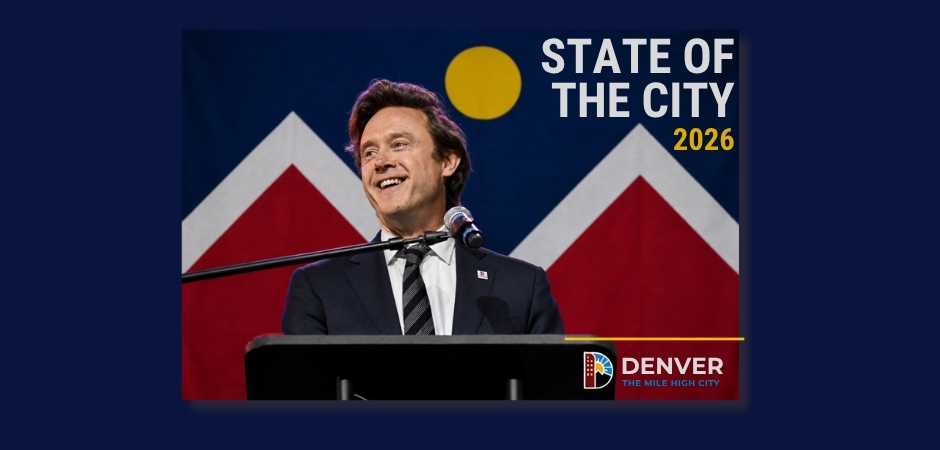
Mayor Johnston Outlines Vision for Denver’s Future in 2026 State of the City
Denver Mayor Mike Johnston delivered his 2026 State of the City address on July 21 at the National Western Center, outlining his administration’s vision for Denver’s next chapter.
Framing affordability as the defining challenge facing the city, Johnston highlighted plans to expand affordable housing, pursue universal child care, strengthen public safety, revitalize downtown and invest in economic opportunity, while pointing to progress on homelessness, housing and crime reduction during his first three years in office.
The speech looked beyond current initiatives to a broader vision of making Denver “the best city in America to raise a family,” emphasizing long-term investments in neighborhoods, infrastructure and quality of life.
Watch the full State of the City address below:
The following is Mayor Johnston’s 2026 State of the City address as delivered:
Welcome to the 2026 State of the City. Thank you for being here tonight.

I want to extend a few thank yous, starting with our City Council and our new Council President, Diana Romero Campbell, as well as our new President Pro Tem, Serena Gonzales-Gutierrez. I also want to take a moment to thank outgoing Council President Amanda Sandoval for her leadership over the past term.
A couple other folks I want to recognize who are with us tonight:
Governor Jared Polis, Attorney General and Democratic Nominee for Governor Phil Weiser, Mayor Michael Hancock, Mayor Pena, and Melat Kiros, Democratic nominee for Colorado’s 1st Congressional District
Thank you for being partners in the work of building our great city.
And thank you to my family and team…
Tonight, my job is to report to you on the state of our city. And I will. But the true state of a city has never been found in budget lines and building permits. It is found in our people. So I want to begin with one of them: a woman whose story still defines the spirit of our city still today.
She was born more than 150 years ago to parents, Melissa and Pryor Warren, who were formerly enslaved. In 1871 they welcomed a daughter, Justina. For all their joy, they knew they were raising a Black girl in a country where she could not vote and was not supposed to set foot in a college classroom. Their dreams could have flickered. Instead, they grew more fierce. They dreamed into her. They told her every day the things she could be.
Fueled by those dreams she excelled in school and graduated high school but did not stop there. She went on to college where she was the only Black woman in her college . She pressed on to medical school and graduated and passed her medical boards to become a doctor. But then the old world closed in. No hospital in Chicago would have her. No practice would take her.
Justina refused to take no for an answer. She went looking for a place that shared her sense of possibility. A place that would welcome anyone willing to work hard and give something back. In 1902, she decided that place was Denver. And when she arrived, Justina Ford became the first Black woman licensed to practice medicine in the history of Colorado.
Things still weren’t easy. Hospitals still refused to grant her admitting privileges. So she bought a house in Five Points and opened a maternity practice out of her living room. And the babies started coming. Black mothers, Latina mothers, white mothers. They all came to Justina’s house.
By the time she retired, she had delivered 7,000 babies. And our historians believe the descendants of the children she brought into this world number 150,000, walking the streets of this city today because one woman came to Denver to chase a dream.
That is not just Justina Ford’s story. It is the story of this city She saw a system that was broken and a country that wasn’t living up to its promise, and she came to Denver because she believed that here she could change it. And when she saw it change here in Denver, that is what gave her hope for the future of her city and her country.
For people like Justina Ford, Denver was the home of the open frontier. And the power of that idea rests with the fact that both words matter: Always open. And always a frontier.
Open means open to all. Denver was a place that did not care who your granddaddy was or how much you were worth. We cared how hard you could work, what you could do for yourself, and what you could do for the people around you.
And always a frontier. Because a frontier is not really a place. It’s a possibility. It is the line between the world as it is and the world as it could be, and it is a standing invitation to cross it. You persevered, you worked together, you refused to give in. The power that fueled this place was never gold or silver. It was opportunity.
And that opportunity does not hide Denver’s hard truths: the promise of opportunity hasn’t always been kept. The Ute, the Cheyenne, and the Arapaho lived on this land for generations before anyone called it a frontier, and the first block built on Larimer street was built in violation of the treaty recognizing it as Tribal land. We were and still are a place that is becoming the dream we have of a land of opportunity. That promise of this place has always been bigger than its failures. Our job is not to repeat these failures. Our job is to keep the promise.
And it is in that call for reinvention that we are still a frontier. Not the frontier of memory, but a place that draws its power from the opportunity to change. People came here because they were stuck someplace else: wrong job, wrong name, wrong race, no way up. They were told to settle for less, and they insisted on more. In a world of cant’s, Denver was built by people who proved you can.
There will always be those who cling to the broken belief that you only get bigger by making other people feel smaller. But the simple math of the frontier is this: division only makes us smaller. Addition makes us bigger. Add more people. Add more cultures, add more beliefs, add more traditions. That is how we grow a place whose strength is the diversity of backgrounds wrapped tightly around a commitment to shared beliefs. If we don’t like it, we can change it. If it’s broken, we can fix it. If we don’t see it, we can dream it. If we can dream it, we can build it.
I don’t need to tell you that the country we love is in a hard season. There are real reasons to be afraid. We’ve watched families torn apart by immigration raids, we’ve seen American citizens killed on the street for raising their voice in resistance, we’ve seen white supremacists marching on our nation’s capital. Foreign wars batter the economy and hand folded flags to mothers who have spent a lifetime using those hands to hold the baby boy they will never hold again.
There are real reasons to be worried. Parents worry, like I do, about how our kids will ever be able to afford a home, worry that they won’t be able to find a job in a world changed by AI, that whatever job they do get may not pay enough to support a family i when the costs of groceries, and energy, and childcare just keep going up and up while paychecks stay the same.
But the greatest fear is not just that bad things are happening. It is that too many Americans have stopped believing things can get better. People promise change and nothing happens. The system doesn’t care, or doesn’t respond, or doesn’t work. The rent doesn’t come down. The jobs never arrive. The childcare slot never opens up.
People who are relying on hope, and don’t see change, end up in despair.
When you keep waiting for things to get fixed and they don’t, you only have two choices, you think the people next door to you are the problem so you tear them down, or you think democracy is the problem, and you tear it down.
Trump has pushed us to believe both.
But in that despair, the most powerful response is not to call him out, it’s to prove him wrong. It is to deliver results that show his theory of the case is wrong,.
Delivering real change is the most powerful tool to fight despair, and to rebuild hope.
That is why in Denver we hold onto a simple and contrarian belief: that our toughest problems are solvable, and we are the ones to solve them.
And to prove it to ourselves, we went at the hardest problem first.
Seth. Seth grew up right here in Denver. His battle with addiction started at 15, with only short periods of sobriety. He moved to Las Vegas hoping a change of scenery would help. His brother got him into ironworking, and for a while he was on his feet.
Then he came home to Denver for a long weekend and started using again. Never went back to work, never went back to Vegas, never made it out of the clutches of addiction. That addiction kept him homeless on the street for four years and landed him in jail. He got out of jail and was ready to take one more shot at getting clean when he got a call from his mom that his brother, the one who helped him get back on his feet, had started using again, and died of an overdose.
Seth was living in his car. He was ready to give up. He said he was ready to die. And then Jessie Milleson knocked on his car window. Jessie worked on our street outreach team, and he asked Seth one question: did he want to come inside?
Seth got out of the car. He moved into a room in one of our All In hotels. He stabilized, he got clean, he started training to become a truck driver, earned his commercial driver’s license,, and moved into his own apartment. He texted me the photo of his mom coming to visit him in his new apartment, before he took her to church. In that photo is the promise of a boy who refused to let his mom bury a second son, who refused to give up on himself, who knew he had something offer, and when his angel, as he calls Jessie, came to knock on the window at just the moment he was ready to give up, he dug in to fight one more time.
So what does it mean when we say unsheltered homelessness in Denver has fallen 64 percent, the largest decline any American city has ever recorded? It means outreach workers like Jessie have knocked on 9,000 car windows and tent flaps and brought 9,000 people inside. It means 8,000 of those neighbors now have a safe place where their kids can play and they can start a life and their mom can come to visit on Easter, and be proud all over again. It means thousands of people this city was told to give up on are giving back to it instead. That is a Denver worth being proud of.
And we aren’t finished. Every success like Seth makes me more impatient about the people we are still not getting to. Because we will never, ever, ever stop fighting for the people who need us most.
In safety – After COVID, La Alma Lincoln Park started to slip. There were shootings. Drug activity moved in. Families stopped going outside. First the games got canceled. Then the baseball league shut down altogether.
A lot of people had written the park off. Two men refused. Commander Aaron Rebetrano grew up in an area of Pueblo not unlike La Alma Lincoln: a well-rooted neighborhood with families that had been there for generations. The desire to serve places like it drew him to the Denver Police Department in 2008. He learned how to be a cop patrolling the streets of District 1, and in 2025 took over as the Commander responsible for this neighborhood. Seth Howsden, the city’s Recreation Director, had watched the decline from his side of the fence.
Reb and Seth sat down with neighbors and asked what needed to happen. The answers were simple: lights in the park. More patrols. Safer crosswalks. So they went to work. They cleared the encampments and the drug markets. DPD established the Colfax Car, a two-officer assignment focused solely on La Alma Lincoln, Paco Sanchez Park, and the Colfax Corridor. Our transportation team put in new lights. Our foresters cleared dead trees and shrubbery. Our licensing team enforced against bad behavior at nearby convenience stores. Parks and Recreation filled the calendar with events. And they brought baseball back for the first time in years.
The result: total crime in La Alma Lincoln down 31% in one year. Violent gun crime down 45%. And the same is true across Denver. Between 2020 and 2023, this city averaged close to 100 homicides per year. We have cut that almost in half.
But that doesn’t mean our work is done, progress doesn’t always move in a straight line. At the beginning of this summer, we started receiving reports that La Alma Lincoln was seeing issues again. We didn’t wait for it to get worse. Seth and Reb and our neighbors went right back to work to make sure history would not repeat itself.
These are the partnerships we are setting up all over the city five of the six locations have not had a single shooting this year. It works because it is not a one-time fix, it is an ongoing partnership between neighbors and police and other city agencies to address each concern as it arises.
This is our commitment. It isn’t a promise that there will never be problems. It is a promise that we will never shy away from tackling them together.
One of the biggest challenges we’ve taken on is housing. On kitchen counters all across Denver, the largest bill waiting to be paid is the rent check. People love this city. They moved here, they built lives here, and every year they wonder whether they will be able to afford to stay. A city you cannot afford to stay in is not open, no matter what the sign says. So we went to work using every lever we have.
To encourage new construction, we transformed a permitting process that took three years into one that now takes 180 days. Today nearly 90% of permits go out on time, almost double what it was 3 years ago. We committed to building housing at every income level to open up supply. We’ve delivered 6,000 dedicated affordable units, where families pay no more than 30 percent of their income.
And we started turning empty office buildings into homes. Last week we opened our first office conversion at the Denver Tech Center: 143 new affordable apartments. One of the first residents is Keren, a single mom of two, who teaches at Swigert elementary school. In her spare time she runs a nonprofit bringing afterschool programming to kids who need it. She moved to Denver because, in her words, this city is truly the best place for her kids to grow up.
We know a place you can afford makes Denver feel like home. That’s why we celebrated when some rents in Denver came down as much as 10% over the past 18 months, among the steepest declines in the country. But the real measure of success isn’t just the numbers. It’s this: the more we bring down rent the more teachers, coaches, servers and nurses will live in this city they love and stay in this city they serve, and that is what makes Denver vibrant, and that makes Denver affordable. Keren, can we give you a round of applause?
When we took office, we made a promise about downtown: not just to restore what it was before COVID, but to build the downtown of the future. The economic engine of the city. A place to eat and sing and cheer and laugh.
We fully re-opened 16th Street, our city’s main street, rebuilt end to end and filled again with art, music, shops, and people from all over the world. We’ve welcomed 108 new downtown businesses since January 2025, and more than 2,500 new homes are built, underway, or in the pipeline. Pride and the Outside Days festival drew nearly 1.2 million people downtown. The incredible World Cup watch parties at Skyline Park gathered more than 60,000 people to watch 100 games together. And to make it easier to get downtown this summer we launched Mayor’s Park $5, opening thousands of parking spaces for just five dollars, so the hardest part of a night downtown is deciding where to eat or what show to catch, not where to park.
Now, downtown foot traffic is back to 90% of pre-pandemic levels, and we’re just getting started.
But what matters most is who is carrying the comeback. Our vision is for downtown to represent the best of Denver, only in Denver. It is the place where you can find your favorite neighborhood restaurant or favorite local brand all downtown. And that’s what’s happening. Somdee, one of our favorite Thai restaurants in Uptown, will be opening a signature restaurant downtown. Frank and Jacqueline Bonanno, Denver restaurant legends, will be opening their next great venture, Romyo on Larimer. Milk Tea People will be expanding their successful location to 16th Street. Konjo Ethiopian, is planning a second location on 16th Street, bringing authentic Ethiopian food and culture to downtown. And Halfdays, the women-owned outdoor brand that had offices around the country relocated everyone to Denver and planted themselves at the base of the mountains they outfit, with a new office on Wynkoop and a flagship store on Walnut. Can all of those folks helping make downtown Denver stand up
And we want more businesses to make their mark right here in Denver. That’s why this month we announced the Denver Jobs Agenda, which will support 10,000 jobs across the city, will help Denverites find jobs that pay a family wage, it will help launch and grow small businesses like Konjo, and will help attract more great companies like Halfdays to call Denver home.
And our residents are betting on this city too. Last fall, almost 70% of Denver voters passed the Vibrant Denver bond, a billion dollar investment in rec centers, libraries, bridges, and parks in every neighborhood. In a moment full of examples of government that doesn’t work, Denver built proof of what does. That is a city betting on itself.
Everything we have built, we have also been willing to defend. Because there is one more rule of the frontier: we never go looking for a fight, but we never dodge one when trouble comes for the people we love and the values we live by.
That’s why when the Trump Administration tried to cancel our funding for standing up for diversity, we took them to court. When they tried to strike down a commonsense assault weapons ban that has protected this city for 37 years, we said Hell No, and we fought back with everything we have. And we will continue to do that for anyone in our community being bullied by this administration.
These stories are not evidence of a mission accomplished, they are proof that change is possible, and that real change is the true source of hope. When we see we can commit ourselves to working on something, and together we make it better, that is the essential fuel of the frontier, the self-evident truth that good people working together can change their world.
And when we were tested, Denver proved what it looks like to find that belief again.
In the middle of these great struggles on homelessness, crime, housing and our downtown recovery, the governor of Texas sent 40,000 migrants to Denver, more than any city in the country. He did it because he believed this would crush our spirit and make us hate each other again.
Instead what the world saw from Denver was not a city who complained or gave up or blamed someone else, it was a city who believed our problems were solvable, even when those problems weren’t of our own making.
And Denver responded.
Moms organized food drives and clothing chains that fed and housed 1000s of people, like Andrea Ryall with the Highland mommies.
Juan, the co-founder of Crosspurpose, who left his role to start his own program and helped more than 12,000 people apply for and receive work authorization.
Rayna in our housing dept housed created new system to get thousands of people housed and many Denver residents, including city employees like Perla and Denver Broncos players like Justin Norwood, brought families to live in their homes and their kids walked hand in hand to school together.
And a year later, after Abbott and Trump insisted migrants would drive up crime and homelessness, the city that had received the most migrants, had driven down crime and homelessness more than any other city in the country.
They believed challenges would break people, and once broken we would turn on each other. What they didn’t know is that when people fight through challenges, and deliver change, when they see that our problems are solvable and we are the ones to solve them, and they see it with their own eyes, then when the next crisis comes we don’t turn on each other, we turn to each other. That is how change drives hope, and defeats despair. And that is what Denver has shown the world.
The frontier was never just about the land. It was about opportunity: open to anyone, as grand as the Rocky Mountains and as vast as our big blue skies. It’s what brought Justina Ford here. It’s what brought all our families here. And to keep this frontier open, we must make that opportunity available to everyone in this city.
A city of opportunity is a place where you can raise a family without going broke. Where you can afford to buy a home in the neighborhood that raised you. Where your kid gets a fair start no matter what block she is born on. That is the standard. And tonight, I want to walk you through the three opportunities that will define our next chapter: the opportunity to thrive, the opportunity to belong, opportunity to connect.
First: the opportunity to thrive.
Every generation on this frontier has faced its own impossible question. How do you cross the Rockies? How do you grow food where it snows in April? Today’s version arrives at 6:45 on a Tuesday morning, and every young parent knows it by heart: who is going to watch the baby?
Here’s the math families are living with. Denver has 31,000 kids under the age of 4 and fewer than 5,000 available licensed childcare slots. Families are paying an average of $25,000 a year for one child. $50,000 for two. $75,000 for three. After rent, some families spend two-thirds of their income before they buy groceries, or pay for school, or a family trip, or a birthday party. That burden, left unchecked, has made cities impossible places to raise a family, a fate we won’t allow Denver to repeat.
Last week, City Council took the first step, ending duplicative licensing requirements that forced providers to do the same work twice. I want to thank them for it. And it is only the first step.
A city of opportunity is a city where quality childcare doesn’t cost more than rent. So tonight we begin the next phase: making Denver the best city in America to raise a family.
Sixty years ago, preschool as we know it barely existed in Denver. But two women were determined to change that. Anna Jo Haynes and Nancy Gary partnered with United Way to launch Denver’s first preschool network through Mile High Early Learning. They spent decades fighting for free full-day kindergarten and later partnered with Mayor Hickenlooper to create the nationally recognized Denver Preschool Program, making preschool available to every four-year-old in Denver. Those two Denver giants are here tonight. Please join me in honoring the visionaries who dreamed Denver’s promise of preschool—and delivered it: Anna Jo Haynes and Nancy Gary.
In their honor, we finish what they started. We carried the promise of universal education to kindergarten. Then to preschool. Tonight, we carry it the rest of the way: universal childcare, for every family in Denver. And we are creating the Haynes-Gary Task Force, charged with delivering the plan to deliver on childcare for all before the end of our second term.
The task force has three jobs. First: cut the red tape, so passionate educators can open and run a quality childcare business without drowning in paperwork. Second: build a pipeline of well-trained, well-paid caregivers. And third: chart the path to make care affordable and accessible for every Denver family within five years.
And we will start the way we always start: by listening to Denver. Over the next six months we will launch a citywide listening tour, going into neighborhoods to hear from the families and providers living this every day. Where families are struggling, where providers are stuck, and what it takes to get this done.
Some cities are betting on server farms as they plan for their futures. We’re betting on our kids.
Rents are coming down and permits are moving faster. But what people want is their own place, a place where the rent won’t keep going up, a home with your name on the deed of something you can own and pass on, your own part of the American Dream. People want a home that tells them Denver is the place they belong, not for a little while, but forever. And for too many Denver families, that dream is out of reach.
As a city, we will not watch from the sidelines as prices stay out of reach. Where we own land, we can make deals that drive down the cost of building new homes. Where we hold financial tools, like the resources of our Downtown Development Authority, we can cut the cost of borrowing so projects break ground in months instead of years. When the city shows up as a partner, more homes get built at every income level, and they get built faster.
That is how a city builds opportunity: with our own land, our dollars, and our political will.
Mile High Line
And finally: the opportunity to connect.
For a hundred years, growth in American cities has been a story of winners and losers. A neighborhood gets hot. Developers rush in, build luxury units the neighbors cannot afford, extract the value, and move on. The growth is not planned. It is not connected. It is not fair. And the people who built the neighborhood get pushed out of it.
We have spent three years assembling the pieces of a different way to grow. Growth that keeps neighborhoods affordable for the families who have been there for generations. Growth that makes it possible for a young family to own a home. Growth that puts housing next to transit, so we spend less time in traffic and more time with our kids. Growth that protects open space in every neighborhood. Growth that builds complete places: housing, jobs, groceries, parks, and an easy way to get anywhere without a car. And tonight, we put those pieces together in a series of seven connected places that will lead this new kind of values-driven growth.
They include a 155-acre park at the old Park Hill golf course, the largest single piece of private land ever turned into a public park in our history. Sixty-five acres at the National Western Center, where we sit tonight, in the heart of Globeville, Elyria and Swansea Communities. The next generation of downtown, from the reopened 16th Street to new office-to-housing conversions. The proposed developments of Ball Arena and the River Mile. Burnham Yard, a 150-acre campus around a new stadium that will host Super Bowls and Final Fours and the people who call it home. Old Mile High, the 85 acres where the current stadium stands that will return to city ownership when the Broncos move. And Santa Fe Yards, future home of the Denver Summit and already home to light rail and a vibrant South Broadway.
Tonight, for the first time, we give them one name: the Mile High Line.
Now, you may have heard about some of these places one at a time. A park here. A stadium there. What is new tonight is the vision we have built that binds them together: one unified promise that Denver’s next decade of growth will be connected, affordable, and owned by the people who live here.
This vision connects all of Denver’s values. The Mile High Line is many things. It’s an economic strategy: these projects will support tens of thousands of jobs. It’s a housing strategy: we will open thousands of new homes across this line. It’s a transit strategy: every one of these projects sits on existing light rail, and we will link them together with a series of bike and pedestrian paths that allow you to live there without owning a car. It’s a climate strategy: walkable neighborhoods powered by geothermal and renewable energy with hundreds of acres of new parks. And it’s an equity strategy: every one of these investments will be made in parts of the city that have waited too long for investment. These projects will be shaped by community voices and guided by one promise: the people who make these neighborhoods what they are must be able to afford to stay and share in what comes next.
These places are a fight for the future of Denver, a fight for a Denver that is open to us, owned by us, and affordable for us.
Let me give you three examples of what that means.
For decades, a privately run golf course sat in the middle of the most historic Black neighborhood in Denver, a neighborhood created when redlining drew an invisible race line across this city. There were giant green fields where you could not throw a football with your son unless you could pay.
Wash Park, City Park, Central Park: other neighborhoods got iconic regional parks. Park Hill never did. That changes now. We’re building the largest new park in 120 years of Denver history in the heart of that neighborhood.
At a time when the president is cutting public lands and closing open space, we commit to do the opposite: to make parks and public spaces more available, more accessible, and more equitable than ever before. That’s why Park Hill is designed to be a world-class park surrounded by transit, grocery stores, restaurants, and homes that working families can afford, so the people who call this neighborhood home can keep calling it home. That is the vision of great spaces in Denver that are open to all of us, and made most accessible to those who have been locked out for too long.
Look around you. The ground we are gathered on tonight sits in some of the oldest neighborhoods in Denver, with deep Latino and Native American roots. Twice, highways were driven through these blocks, and those cuts left scars: cut off from investment, cut off from downtown’s growth, saddled with some of the most polluted zip codes in America. This is a community too many people gave up on. We refuse to do that.
As the new National Western campus rises west of the rail lines, the city will hold 65 acres of the old campus. Now, in partnership with the community, we are dreaming of new opportunities: Housing. Public space. A reconnection to Brighton Boulevard and the growth of neighborhoods south of I-70. And because the city owns this land, we can do what private development never offered here: build with community and for community, and to make it possible for the families who built Globeville, Elyria, and Swansea to have shared ownership in what rises next. That can mean homeownership we help support. It can mean community land trusts that keep property in community hands. It can mean neighborhood investment trusts that allow neighbors to hold shares in whatever development emerges.
After generations of mis-steps and mistreatment, this will at last be home to a neighborhood that grows with its neighbors, for its neighbors, and by its neighbors. And that is a vision of a city that is both owned by us and kept affordable for us.
When I ran for mayor, I was asked about the future of the Denver Broncos. I said they had to stay in Denver, of course, and stay on the west side. And the Broncos’ ownership shared the same bigger vision: that a stadium should not just be a building surrounded by 60 acres of parking. It has to be a community asset 365 days a year, full of restaurants and housing and public spaces. Burnham Yard, a rail yard fenced off for 150 years, gives us that chance. So when the Broncos open their new stadium there and begin hosting Super Bowls and graduations and, I hope, Beyoncé, this city will uncover a once-in-a-century opportunity.
Because that is the day Mile High becomes Old Mile High, and the 85 acres beneath it come back to the city. Land connected to Federal Boulevard, to Sun Valley, to Westwood. In the next year we will start a community process unlike anything Denver has done to meet this once-in-a-century opportunity: neighbors dreaming together about what to build, what to connect, and how to knit back together communities that spent generations disconnected. This can mean thousands of new units of housing, new public spaces, all perfectly connected to Federal boulevard and downtown. That is the chance to reconnect Denver and to ensure the West Denver that was built by us stays open to us and affordable to us.
And there is a reason we chose these places. Between National Western, Old Mile High, and the resources of our DDA downtown, the city holds more than 150 acres and real investment power, all sitting on existing rail. For decades, transit has struggled here because we never built density around the stations. These sites let us build housing we can keep affordable, in exactly the places that make transit finally work.
That is why tonight we are announcing our plan to build 20,000 housing units across this Mile High Line. This won’t just add the housing supply we need to keep Denver affordable, it will provide the density to support the city’s growth into a place where Denverites can rely on public transit to get from where they are to where they want to go.
That is the vision of the Mile High Line: a city that is connected to each other and connected to a shared vision for jobs, housing, transit, climate and equity.
This idea of connectedness is not new. Nita Gonzales and the River Sisters dreamed for years of a turquoise necklace linking the communities of the Platte; her vision shaped ours. Avi Stopper and the Vamos movement spent a decade making it easier to get anywhere from anywhere on a bike; his work, with our bicycle advisory committee and the shared streets partnership, shaped the bikeways that will connect this line. The 5280 Trail team pushed for the path this line will help deliver. The ideas and the leaders were always here. They just were not always heard. The Mile High Line is what happens when a city listens, and leads.
A line is a connection between points. These points are already joined by rail; we will join them by trail. But a line is also a direction. It points somewhere. This one points toward a Denver that is affordable for all of us, open to all of us, and owned by all of us. A vibrant city of arts and sports and commerce that is still closer to the outdoors than any place on Earth. If the airport is our connection to the world, and Union Station is our connection to the West, the Mile High Line is our connection to each other. And Denver is at our best when we are connected.
That is our vision for Denver: A city of opportunity where every child can thrive with childcare for all, a city where people belongbecause we can afford a home, and a city that stays connected, connected to each other and to the shared public spaces that are dreamed by us, open to us, owned by us and affordable to us.
This year, America turns 250 years old. And I promise to get you out of here before she turns 251.
But like any big milestone, it has everyone asking the big questions: who are we as a people? What do we stand for as a nation? Where do we go from here?
Because on her birthday, the America we choose to celebrate is the patriotism of Justina Ford. It is the Tuskegee Airmen, who won a war for a country that wouldn’t seat them at a lunch counter. The Native code talkers, who carried messages no machine could break. The young men of Amache, who volunteered to serve their country while their parents stayed behind barbed wire. The 54th Massachusetts, who fought for a freedom they had been denied. Frederick Douglass, who fought for an America as good as its promise. Patriots, all of them. Americans, deeply. People who loved this country not because she was perfect, but because we were capable of becoming more perfect. In America, it is often those who have struggled the most who fly the largest flag.
And that belief lives freest here in the West, where the constraints of the old world can be left behind. We are Justina Ford, who came here to be a doctor. We are the scrappy Irish and Germans and Italians and Jews who fled the persecution of the coasts. Here is where we built a more perfect version of America: the open frontier. Not because we have reached the promised land. Because we have traveled the farthest in pursuit of it.
Think about what Justina Ford would see if she could walk through Denver tonight. She would see Jessie knocking on a car window, asking a stranger to come inside. She would see Seth submitting applications to trucking companies. She would see Keren grading papers in a home that used to be an empty office, and kids playing baseball under new lights while Reb and Seth look on with pride. She would see entrepreneurs of color opening their businesses on Denver’s iconic 16th Street. And she would recognize all of it. Because it represents exactly what she was doing in that living room in Five Points more than a century ago: not waiting for hope to arrive, but making the change that creates it.
I know she would have loved the moment when the Denver Summit, Denver’s first professional women’s soccer team, took the field for the first time. More than 60,000 people showed up with them: the largest crowd ever to watch a U.S. women’s professional sporting event. At that game, you could see Denver in every face. Young and old, every race and religion and neighborhood, wearing the same jersey. That wasn’t just a team showing up. That was a city showing up. Not because we are perfect. Because we are becoming.
Justina Ford came to Denver looking for the open frontier. Now it is our job to hand her descendants, and ours, what that frontier promised all along: a city of opportunity. Always open to anyone. A real chance for everyone. The chance to thrive, the chance to belong, the chance to connect in places full of the ordinary joy that makes Denver home.
In a moment when people had lost faith that something better was possible, Justina built that city, one life changed at a time. For the last three years, so have we. And we’re just getting started.
Because that is the lesson of her life and of this city: it is not hope that drives change. It is change that drives hope.
That relentless pursuit of change that matters for every Denverite, that is how we build this city, that is how we save democracy, that is how we bind this country back together, and that, on her 250th birthday, is what America wants most desperately of all.
Editor’s note: Learn more about Mayor Mike Johnston’s Programs and Initiatives online at www.denvergov.org.