
The Outsiders “Stay Gold” in Denver: A Review
The Outsiders arrived in Denver on Sept. 8, and immediately pulled audiences into mid-century Tulsa, with an impressive whirlwind of wit, grit and grief.
The Tony Award-winning musical continues at Denver Center for the Performing Arts’ (DCPA) Buell Theatre through Sept. 27, giving Denver audiences just under three weeks to experience an immensely talented cast and some of the most ambitious technical staging to come through the theater. Over the course of approximately two and a half hours, the show moves easily between humor, tenderness, violence and loss. It’s driven by powerful vocals and immaculate choreography, lighting and sound that transform the stage during its most consequential moments.
For audiences who already know S.E. Hinton’s novel or Francis Ford Coppola’s 1983 film, there is plenty that will feel familiar without making the production predictable. Those encountering Ponyboy Curtis and the Greasers for the first time are quickly introduced to a cast of characters drawn with enough warmth, humor and individuality that affection comes quickly.
The Outsiders is an emotionally gripping production with a plot that feels so personal that it’s almost difficult to watch. It’s heart-stopping in one scene and completely heartbreaking in the next.

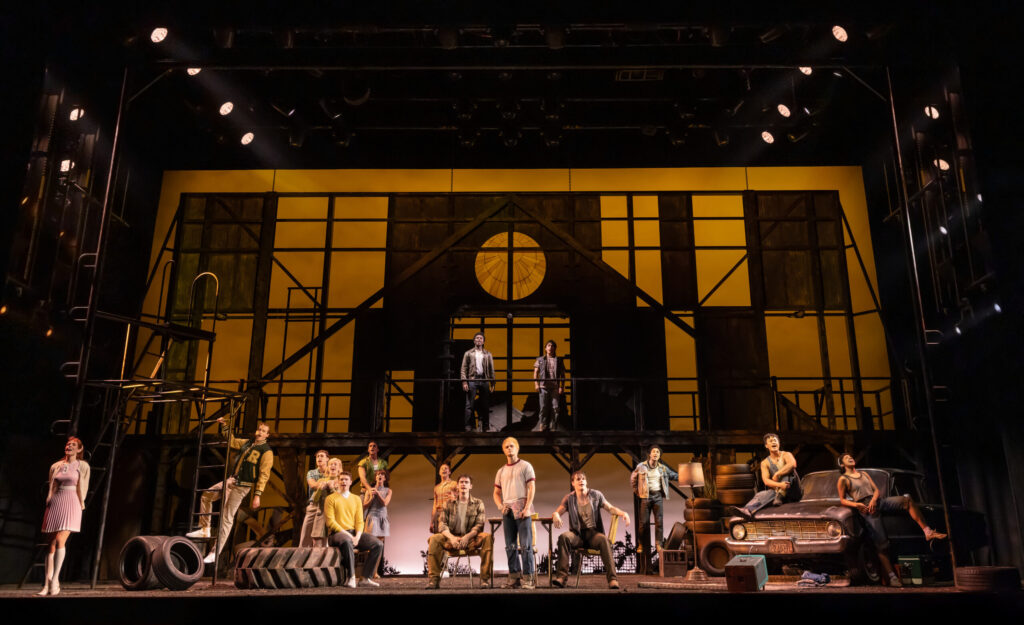
The story unfolds on a stage set with prominent but simple props, depicting the economically disadvantaged East side of Tulsa. The viewing experience is made exceptional by how consistently each of the show’s elements support one another. The actors do not disappear beneath the visual spectacle, and the technical design does not function merely as decoration. Voices, bodies, light, sound and imagery come together to tell the same story, with outstanding precision.
A familiar divide
Adapted from Hinton’s 1967 novel and Coppola’s star-studded film, The Outsiders follows Ponyboy Curtis, his best friend Johnny Cade and a group of working-class teenagers known as the Greasers. Their primary rivals are the Socs – short for Socials – whose wealth and social standing place them on the other side of a persistent class divide.
Greasers versus Socs is not a new story. It is a fictional representation of the haves versus the have-nots, with young people inheriting social positions they did not create, but are expected to occupy. Stuck in “the way things have always been,” the conflict is heightened by the relative smallness of their world. In Tulsa, the groups are forced into constant proximity, but separated enough by class to experience the same city in profoundly different ways.
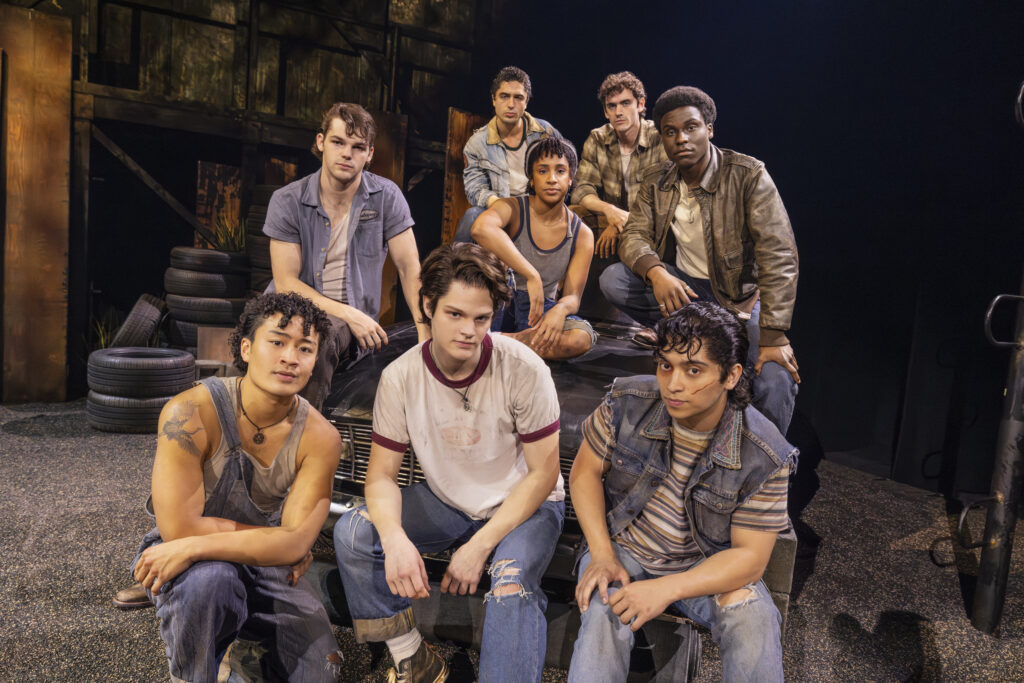
Photo by Matthew Murphy, provided courtesy of DCPA.
For the Greasers, money is only part of what they lack. They also live without the security it can provide. A fight, a poor decision or an encounter with the wrong person carries consequences that extend far beyond a single night. Contrary to the Greasers’ beliefs, Socs have problems of their own; but they possess an insulation from consequence that their counterparts do not.
Without reducing either group to a symbol, the production allows key differences to emerge through its characters.
Cherry Valance, played by Emma Hearn, is particularly important to the story’s complexity. As a Soc who forms an unexpected connection with Ponyboy, she provides the first indication that Tulsa’s dividing line is not as simple as either side thinks. Hearn gives Cherry a soothing, elegant voice that, whether speaking or singing, makes her consistently pleasant to hear. Her scenes with Ponyboy are among the production’s softer moments, offering both characters an opportunity to look beyond the identities their respective groups have assigned.
The complexity of the musical surpasses adolescent awakening, but mutual understanding does not erase structural inequality.
Photo by Matthew Murphy, provided courtesy of DCPA.
A family under pressure
At the center of the production is Ponyboy Curtis, played on opening night by Christian Arredondo, who celebrated The Outsiders Mile High arrival on his birthday.
Winning the audience over with his youthful charm and buttery voice, Ponyboy is a teenager who imagines a life beyond what is in front of him. He reads, thinks deeply and has not accepted the harder worldview that the older Greasers have developed. Arredondo’s openness appears as a natural quality without making Ponyboy seem juvenile or naïve.
As circumstances around Ponyboy grow more dangerous, his early energy gives way to fear, anger, grief and a growing awareness that life can change much faster than a person can prepare for it. Arredondo preserves enough of Ponyboy’s youthfulness that even his hardest moments still belong to the boy audiences met at the beginning.
His home life adds another layer to his coming of age story. Following the death of their parents, Ponyboy and his brothers Darry and Sodapop are attempting to remain together as a family while occupying roles that “make the house a home.”
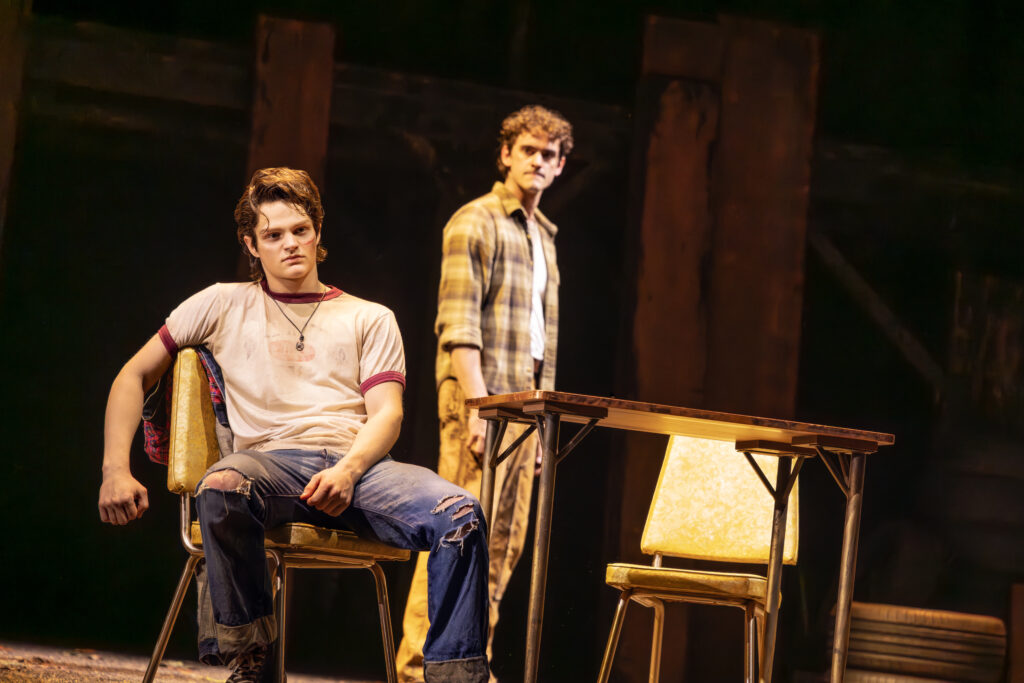
Photo by Matthew Murphy, provided courtesy of DCPA.
Darrel “Darry” Curtis, played by Travis Roy Rogers, carries the weight of the world on his shoulders. As the oldest brother, he has been forced to become a caretaker before he has had the opportunity to finish becoming an adult himself. His seriousness can appear severe, particularly through Ponyboy’s eyes, but Rogers gradually makes the strain beneath that strictness impossible to miss.
Darry seems incessantly aware that his family is at risk. His rules, anger and frustration emerge from that pressure. Instead of him being controlling, he is frightened by how much depends on his ability to protect his younger brother, and the responsibility is becoming increasingly heavy.
Sodapop Curtis, played by Corbin Drew Ross, occupies a much softer space between them. His lovable demeanor and humor provide some of the show’s most natural comic relief, while his affection for both brothers gives the Curtis household warmth even when tensions are high. Ross pairs an easygoing quality with a gentle voice, making Soda a character whose presence is comforting without becoming inconsequential.
The Curtis brothers’ relationship feels like a family. They travel between frustration and protection, making vulnerable moments considerably more effective.
The same emotional investment extends to Ponyboy’s chosen family.
Always a Greaser
Ponyboy’s friendship with Johnny Cade, played by Bonale Fambrini, carries much of the story’s emotional weight as the two boys confront circumstances neither could have anticipated.
Fambrini portrays Johnny with a quiet vulnerability, soft-spoken and visibly struggling with the physical and emotional effects of the Socs’ brutality and violence at home. His subdued presence stands in contrast to some of the louder personalities among the Greasers, giving Johnny a fragility that makes his bond with Ponyboy particularly affecting.
Dallas “Dally” Winston, played by Tyler Jordan Wesley, is another standout from the moment he steps onto the stage. His vocals are immediately impressive, but the strength of his characterization is equally commanding. Dally learned early that vulnerability can be dangerous and built a hardened version of himself in response. Wesley makes his toughness believable, and in moments when it begins to fracture, the portrayal carries considerably more weight.
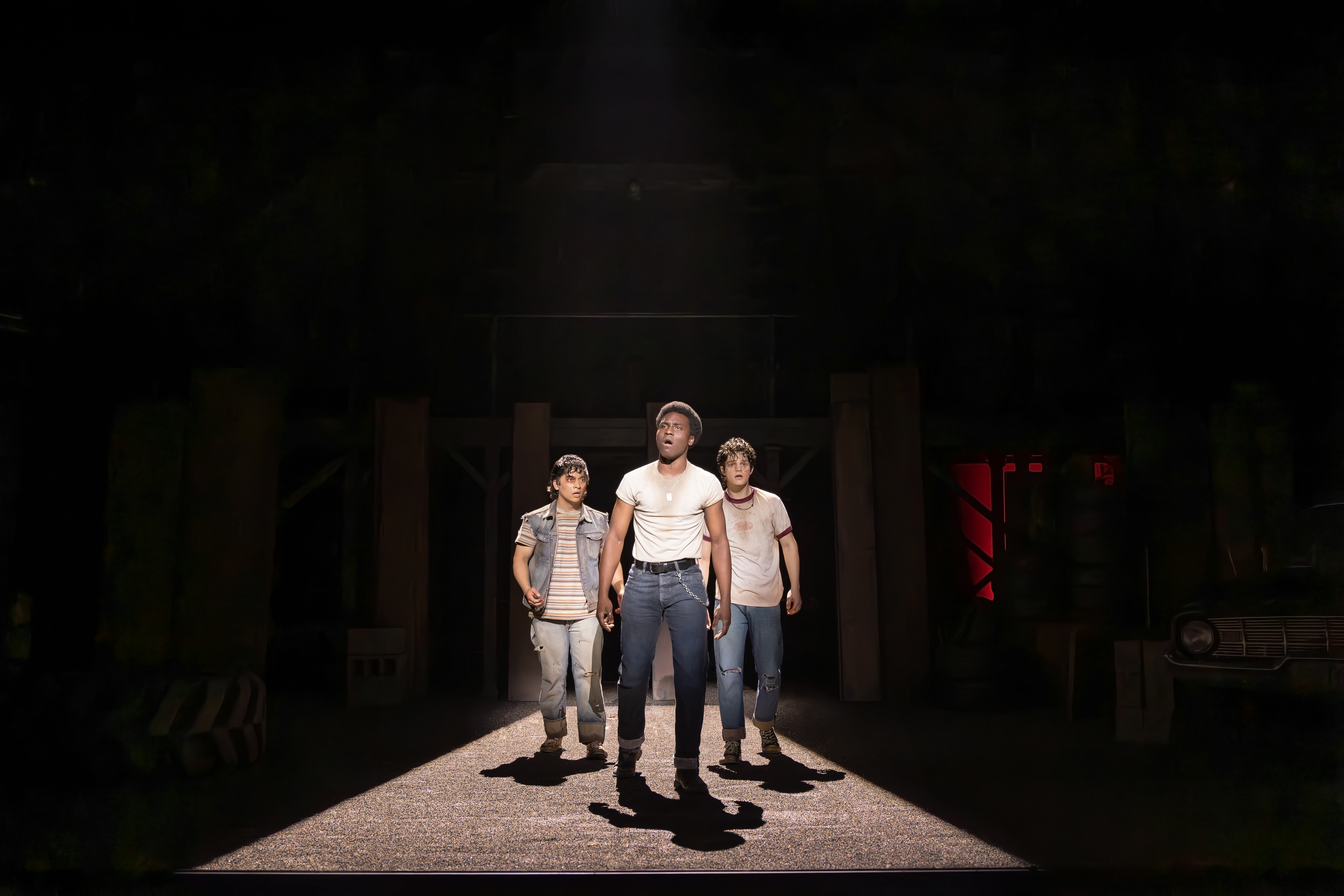
Photo by Matthew Murphy, provided courtesy of DCPA.
Across the company, the vocal ability is spectacular. Individual voices are distinct, while the fullness of the ensemble vocals gives each number an imposing force and emotional texture. In a production filled with technical spectacle, the characters add humanity that matters most.
The language of movement
Nominated for a 2024 Tony Award for Best Choreography, The Outsiders features outstanding dance scenes that stimulate the senses and blend seamlessly with perfectly-timed lights and sound.
Choreographed by Rick and Jeff Kuperman, the movement rarely feels separate from the storytelling. The Greasers’ physical vocabulary reflects their relationships – there is swagger, roughhousing, restlessness and a perpetual awareness of the bodies around them.
The choreography captures the energy of young men and women who seem more comfortable expressing loyalty physically than explaining their feelings with words. At other times, that same physicality turns aggressive, revealing how easily posturing can become violence when pride, fear and social pressure collide.
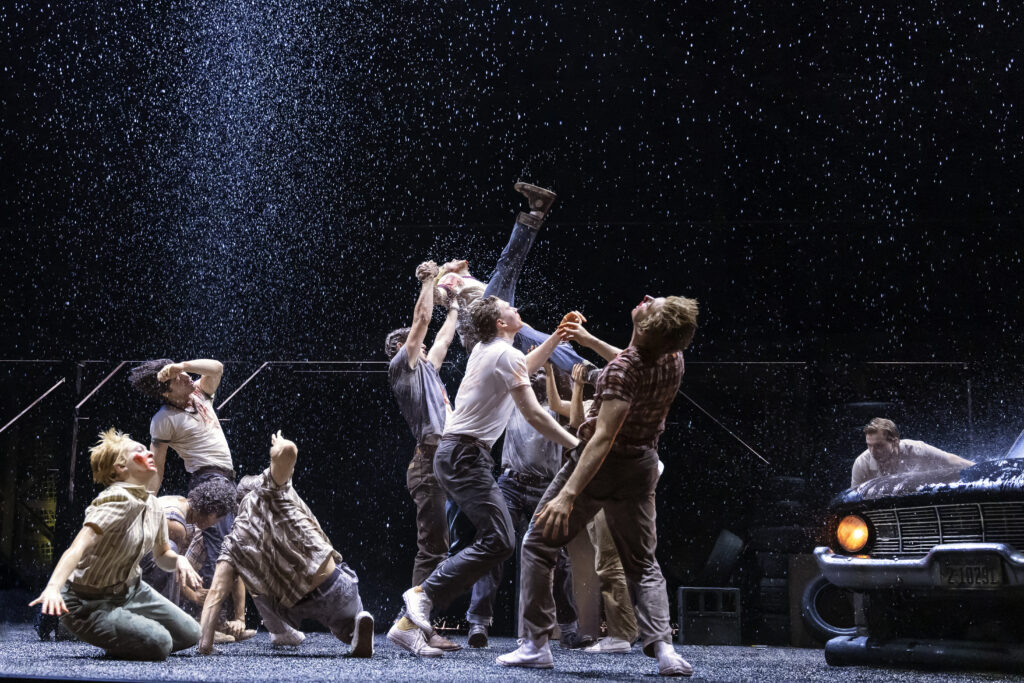
Photo by Matthew Murphy, provided courtesy of DCPA.
One of the production’s most extraordinary sequences occurs during a fight over the town’s park. The choreography, lighting, sound and visual design converge as actors move through an increasingly dangerous confrontation with spontaneous intensity. As cast members move through complicated sequences, the timing of lights, sound and visual effects add fluidity and intrigue.
Throughout the musical, the choreography sustains that precision, producing moments that help explain the production’s critical acclaim.
Immersion through design
The technical staging of The Outsiders changes what the audience perceives as possible within the physical boundaries of the Buell Theatre.
Brian MacDevitt and Hana S. Kim’s lighting design and Cody Spencer’s sound design won Tony Awards in 2024, honors that are immediately understood once encountered.
During several climactic sequences, light, sound, imagery and choreography combine to produce an effect that feels almost three-dimensional. Light cuts through the stage and changes the audience’s perception of depth. Sound seems to move through the theater rather than simply emerge from it. Bodies appear, disappear and reemerge as the visual landscape changes around them.
At its most immersive, the sensation is comparable to a sophisticated virtual reality ride. The audience remains seated, but the convergence of visual and auditory cues creates the impression of movement and proximity. For brief stretches, it feels as though the stage has expanded beyond its actual dimensions.
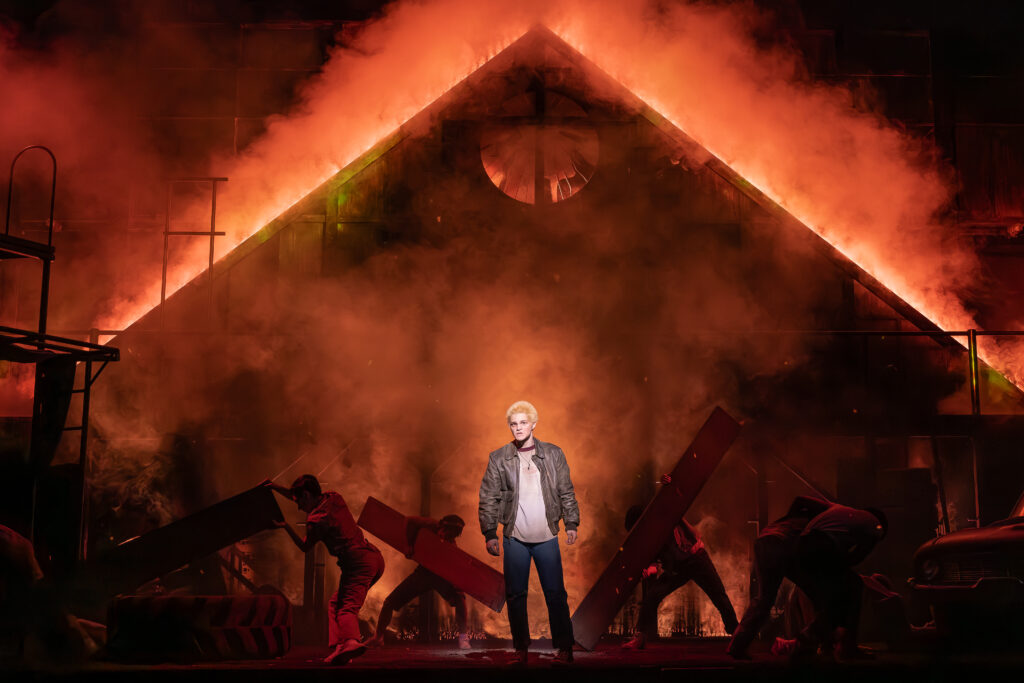
Photo by Matthew Murphy, provided courtesy of DCPA.
The effect is phenomenal, but the balance adds brilliance. Spectacle without purpose would quickly become exhausting, but The Outsiders does not overwhelm. When the emotional experience of the characters calls for disorientation, danger or instability, the audience is pulled closer to what they are feeling rather than distracted from it.
The quieter scenes are allowed a different visual language, restrained by the simplicity of the set. The result is riveting because it is carefully controlled.
Hope inside the hardness
The original score by Jamestown Revival and Justin Levine moves comfortably within the world of the production, drawing on folk, rock and Americana influences.
“Great Expectations” is one of the show’s strongest musical moments and a personal favorite. Delivered by Ponyboy, it looks beyond the immediate circumstances of his life and wonders whether something else is possible.
For young people whose futures are unfairly shaped by class, family circumstances and the expectations of everyone around them, having great expectations becomes an act of resistance. Ponyboy’s desire for something more does not protect him from what happens next, but it takes the story beyond tragedy.
Staying power
The Outsiders satisfies theatergoers who know the story without depending on nostalgia. Hinton’s novel has been read by generations of young people, and Coppola’s film created its own enduring cultural memory. Despite a significant portion of the audience already knowing the characters, relationships and events awaiting them, the musical still finds ways to surprise.
Familiar scenes are reconsidered through movement, light, sound and proximity, creating tension even when the outcome is known. Audiences may recognize where Ponyboy’s story is headed without knowing how the production intends to take them there.
For someone unfamiliar with the novel or film, the story is accessible and engaging. Whether longtime fans or new to the story, Ponyboy, Johnny, Dally and the Curtis brothers earn the affection of each audience member. They are funny and frustrating, impulsive and frightened. They tease, fight and cling fiercely to the families they have been given or created. Even as tragedy begins to reshape their lives, they remain recognizable as young people who are still figuring out who they are.
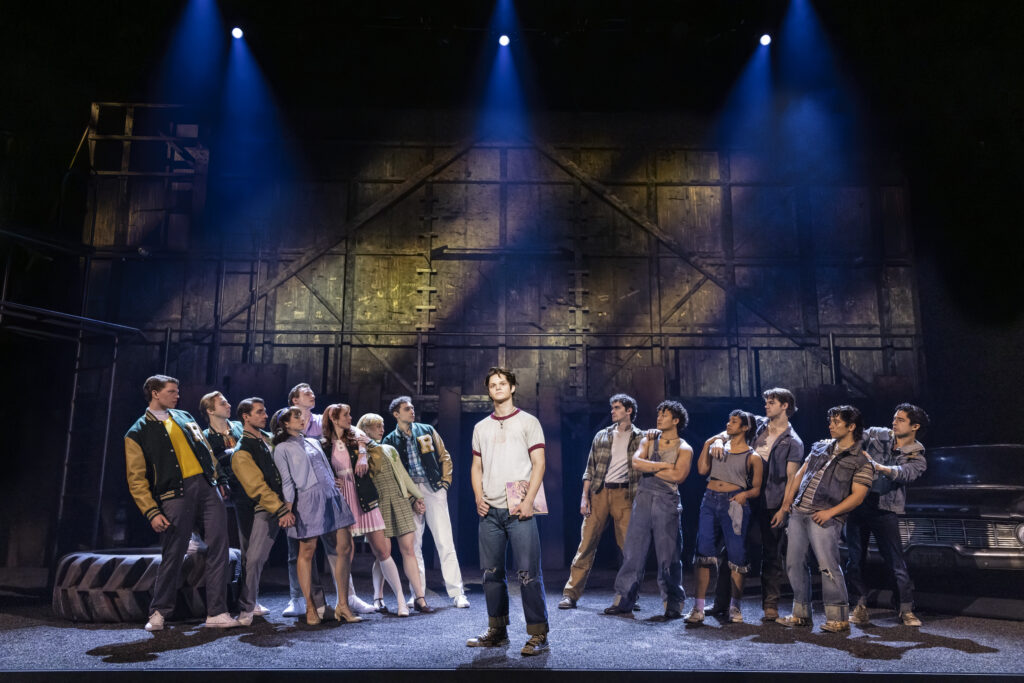
Photo by Matthew Murphy, provided courtesy of DCPA.
By the time the production reaches its final scenes, the audience has traveled a considerable distance with Ponyboy. What begins with youthful energy, jokes and rivalry has moved through violence, grief and the painful loss of innocence. Healing does not arrive by erasing any of life’s realities. Hope emerges from what remains, and from the possibility of moving forward.
The Outsiders is one of the best theatrical productions I’ve seen. Each element works together with technical achievement and emotional credibility to create a visceral experience without losing sight of the people inside Tulsa.
Editor’s note: The Outsiders will play in Denver through Sept. 27. Tickets are available at denvercenter.org.
