
Invisible Borders and Walls that Divide
Examining an immigration crisis that has separated families, terrorized communities and revoked access to basic human rights.
Treading the path of uncertainty with faith and fortitude guiding each footstep, people from all walks of life have migrated to the United States with the expectation that her promise of liberty will welcome them with open arms.
Leaving homes, families and familiarity behind, they travel through hell and high water, undeterred by the barbed wire and border patrol guarding these stolen lands.
They bring very few possessions, but arrive with an abundance of hope – hope that the U.S. will offer sanctuary from political persecution, war and starvation; that better opportunities await; and that their children will be safer, stronger and supported in the land of the free.
They remain brave, even when bigoted leaders shout, “This is not your home.”

For all their troubles and painstaking travels, they are either detained and denied basic human rights or thrust into the center of a brutal debate and painted as delinquents, drug lords and undocumented “animals.”
Demonized by domestic “enemy” rhetoric, unauthorized migrants – or immigrants – who have come to this country seeking shelter are facing the threat of deportation and arrest in one of the most shameful chapters in recent history. While this deeply troubling moment in time will be remembered as a stain on our nation’s conscience, people are taking a stand and showing up in solidarity for communities that deserve more than just sympathy.
What Makes Us Human?
Migration has occurred since the beginning of time, starting with the intercontinental movement of early human species from Africa to Europe and Asia. The colonization of the Americas found waves of European settlers traveling across the Atlantic Ocean in search of economic opportunity and religious liberty.
Their arrival led to the genocide of approximately 56 million indigenous people and the enslavement of an estimated 12.5 million abducted Africans, followed by the creation of regulations that have complicated global travel and naturalization.
For many, the price of authorized immigration is too high. Visas, passports and citizenship tests create insurmountable barriers for those escaping atrocities in their homelands.
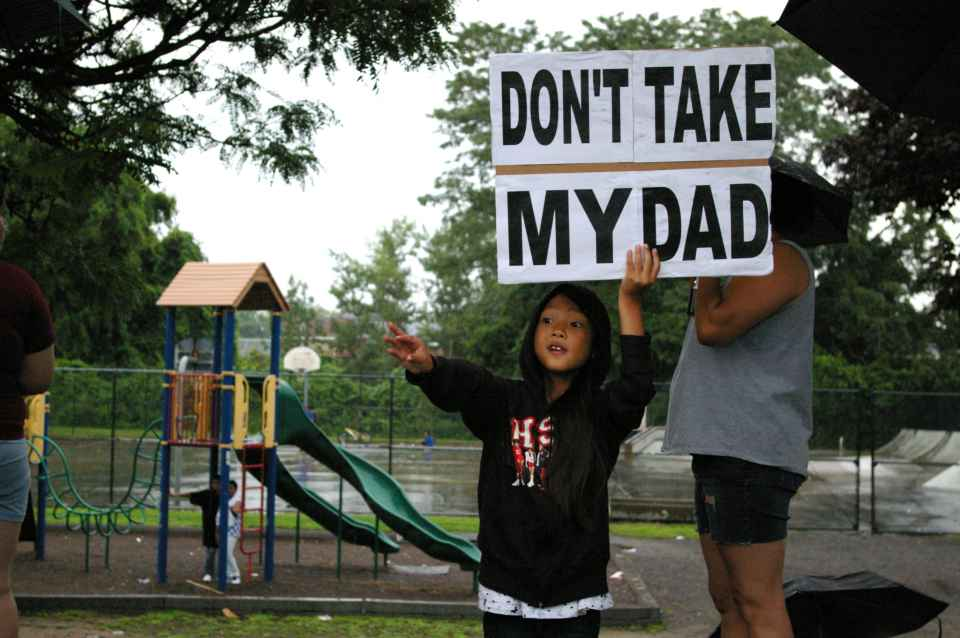
The U.S. Constitution extends protections like due process and equal protection clauses included in the Fourteenth Amendment, but anti-immigration sentiment is rooted in stripping fundamental rights and dehumanizing even the most vulnerable for their failure to enter “the right way.”
Immigration has become one of the country’s most salient political debates. As lawmakers and voters grapple over the topic and its socio-economic considerations, demands for increased border protection are growing in intensity.
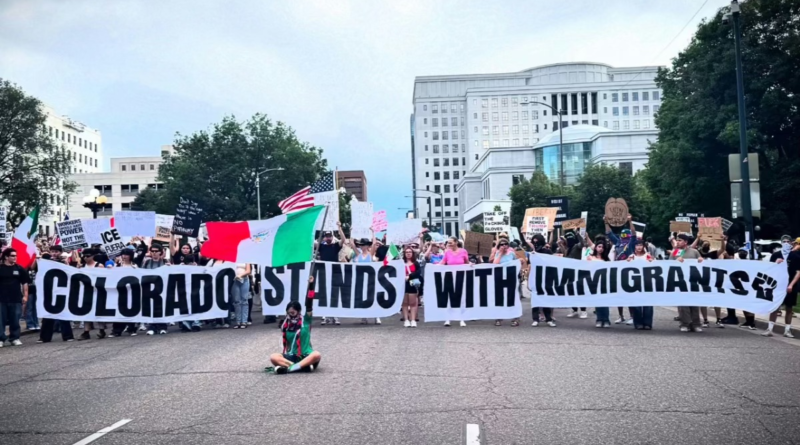
In Colorado and other major cities across the U.S., calls for fundamental rights, dignity and social justice are mobilizing communities against a system that has lost sight of its humanity – all while fanning the flames of resistance in the fight for reform.
The First 100 Days
With immigration at the heart of the 2024 U.S. General Election, President Donald Trump immediately enacted several executive orders on the day of his inauguration, including one focused on “Protecting the American People Against Invasion.”
One of the most controversial developments in the first 100 days of his second term, was the invocation of the Alien Enemies Act, a wartime law passed in 1798 allowing executive authority to detain or deport those who were citizens of countries at war with the U.S. without a legal hearing.
Following the rescission of Proclamation 9844 in 2019, he issued an executive order “Declaring a National Emergency at the Southern Border of the United States” on his first day in office.
“America’s sovereignty is under attack. Our southern border is overrun by cartels, criminal gangs, known terrorists, human traffickers, smugglers, unvetted military-age males from foreign adversaries, and illicit narcotics that harm Americans, including America,” he penned.
Fire and ICE
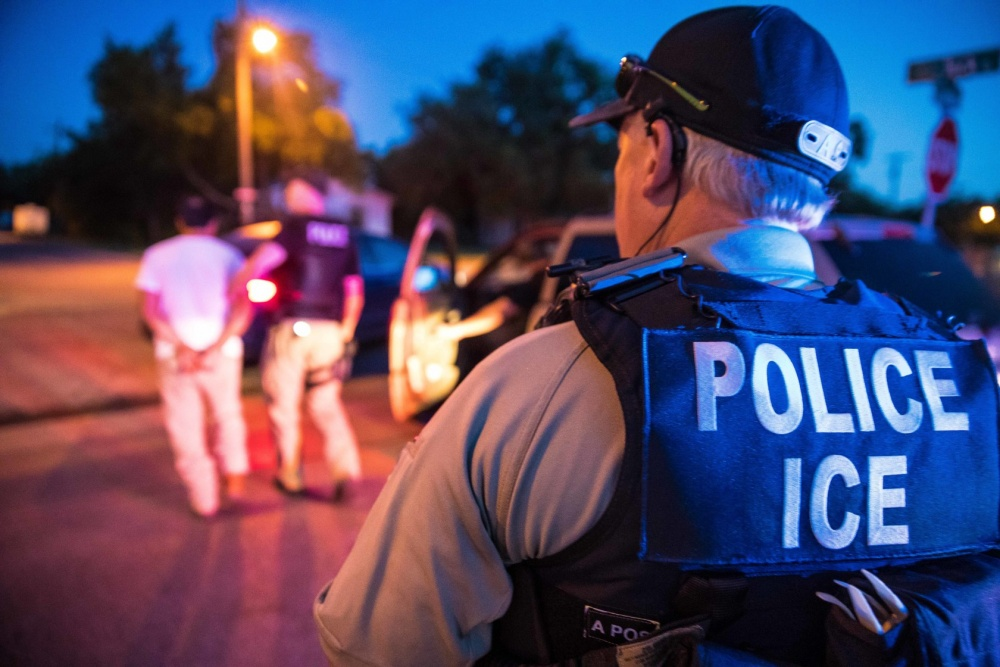
Section 287 of the Immigration and Nationality Act provides US. Immigration and Customs Enforcement (ICE) officers with the authority to arrest unauthorized immigrants without judicial warrants. President Trump expanded the department’s authority and revived the Task Force Model (TFM), deputizing state and local law enforcement officers to enforce immigration laws during routine police duties. The Department of Homeland Security (DHS) also rescinded earlier mandates regarding the protection of “sensitive locations” such as schools, hospitals and churches.
Rapid deportation and the traumatization bled into months of quiet stirrings and grassroots efforts until protests erupted in Los Angeles on June 6.
The Trump administration deployed Marines to California, federalizing National Guard Troops to “protect federal personnel and property.” The action incurred a lawsuit by Los Angeles Governor Gavin Newsom, and six months after the president took an oath to protect the American people, a U.S. appeals court ruled that President Trump is within his rights, despite the unconscionable risk to civilians.
Covering the Chaos
Protests against the mass deportation campaign have spread throughout the country, including in Colorado. Local newsrooms have played a crucial role in documenting the crisis and elevating unheard voices in light of this growing crisis, but there are growing concerns about censorship, funding and safety amid the chaos.
In response, Colorado News Collaborative (COLab), an initiative created by the Colorado Press Association and The Colorado Independent, is leading efforts to familiarize journalists with First Amendment rights, including freedom of the press.
To amplify the impact of immigration reporting, award-winning journalist Stephanie Rivera is steering a data-collection project to track how sheriff departments around the state cooperate with ICE during non-citizen detainments. As COLab’s Collaborative Reporting Project Manager, she hosts listening circles to deepen newsroom-community ties and better inform audiences.
Rivera encourages journalists covering immigration to heighten understanding by first identifying a target audience; then, by listening.
“It’s active listening, and consistent listening. It’s not just holding one forum and then forgetting about them,” she explains. “That plays into mistrust, when people feel like you’re just extracting information and forgetting about them.”
Strangers Among Us
For Papa Dia, Founder and President of the African Leadership Group (ALG), listening is the first step in understanding.
“Currently, there is a propaganda that’s intentionally doing whatever it takes to divide us,” says the community mentor and leader, who immigrated from Senegal to America in 1998. He warns against overlooking immigrants’ humanity without taking the time to get to know them, and encourages people to see what’s happening in the migrant community through a lens of empathy and understanding.
ALG has provided services to thousands of people who immigrate to Colorado from Senegal, Burkina Faso, Mali, Togo, Ethiopia, Eritrea, Sudan and other African nations since 2006. When increased ICE activity began in January, many of its beneficiaries were detained, prompting Dia to temporarily suspend language classes and programs offering food, clothing and legal assistance.
“It’s clear that my responsibility is to protect and provide for my community as much as I can,” he says about his decision to reopen.
“It’s not an easy task. At times you are exhausted, and at times you are worried.”
Close to Home
According to the American Immigration Council, approximately 10% of Colorado’s population are immigrants. Since late 2022, the city of Denver added over 40,000 migrants to that figure, offering sanctuary and services to new arrivals who were deployed here involuntarily. However, humanitarian outreach has come at a cost – and the stakes keep getting higher.
During his electoral campaign, President Joe Biden promised to increase pathways to legal immigration and raise the annual refugee cap to 125,000, with a large portion of those slots reserved for African refugees. His reforms drew the ire of Republican lawmakers, although he only raised the cap to 62,000 and failed to clear a backlog of 7.8 million applications. Eventually, his administration announced that it would reinstate Trump-era “Migrant Protection Protocols (MPP).
For Texas Governor Greg Abbott, the overwhelming influx of migrants and asylum seekers from places like Haiti, Nicaragua, the Democratic Republic of Congo and Venezuela sparked a politically-charged response. He loaded buses with detainees from the Texas border, and shipped them to Washington D.C., New York, Chicago, Los Angeles and Denver.
On Dec. 14, 2022, former Denver Mayor Michael Hancock addressed his constituents, saying, ““Let me be frank: This influx of migrants, the unanticipated nature of their arrival and our current space and staffing challenges have put an immense strain on city resources to the level where they’re on the verge of reaching a breaking point at this time.”
The city spent over $800,000 on emergency operations, including shelter activations and the allocation of financial assistance.
Inherited Hardship
In April 2023, Mayor Mike Johnston was elected as Denver’s new mayor. When he took office in July, he inherited a costly crisis. Implementing a Denver Asylum Seeker Program (DASP), he managed to reduce expenditures from an expected $180 million to $79 million.
Still, Common Sense Institute Colorado reports that schools in the Metro Denver area spent an estimated $228 million on approximately 15,000 migrant students during the 2024-2025 school year, and the city’s safety net hospital system reported expenditures of $10 million in 2023.
Initially receiving only $4.85 million in shelter reimbursement funds from the Federal Management Agency (FEMA), Mayor Johnston announced a citywide 10% departmental budget cut and hiring freeze.
When called to testify before the Committee on Oversight and Government Reform, he addressed the immigration crisis with compassion and an explanation for why the city responded with open arms.
“Denverites believe that our problems are solvable, and we are the ones to solve them,” he stated. “As the Mayor of Denver, I could not be prouder of how the members of our community – groups of moms, our local law enforcement, nonprofits and faith organizations, and so many more – rose to the challenge presented by the influx of immigrants.”
In May 2025, the Department of Justice filed a lawsuit against the city and county of Denver, Colorado’s governor and attorney general, the state legislature, and Denver Sheriff Elias Diggins, alleging the obstruction of federal immigration enforcement in response to “sanctuary laws.”
“There is no law that Denver has broken,” Mayor Johnston states, confirming that the city avoids immigration status checks to protect civil liberties while still cooperating with federal agencies.
The Trump administration attempted to withhold funding for Denver’s transportation programs, and placed a freeze on federal funding that supports city law enforcement and healthcare when a judge issued a preliminary injunction on its earlier actions. The City and County of Denver responded to the funding freeze with a lawsuit of its own.
Joined by Chicago, Boston, San Francisco and Seattle, the lawsuit alleges a violation of the U.S. Constitution’s separation of powers, the Administrative Procedures Act and has acted beyond its scope of powers.
In the midst of the political turmoil and heightened tensions, the fate of millions of unauthorized immigrants rests in the balance.
From Outrage to Community Action
In 2022, social and economic conditions were slowly returning to normal after the coronavirus pandemic turned the world upside.
“Our mayor tried so hard to keep his promise of getting 1,000 homeless people off the street by Christmas 2023,” says local activist and community advocate H. Malcolm Newton. “People don’t realize what he was up against.”
As legal battles continue to brew, different perspectives among Colorado communities became increasingly vocal.
According to the Denver Post, the number of people who identified immigration as a “very serious problem” in Colorado rose from 34% to 54% between 2023 and 2024; but, with countless helpers showing up for the migrant community, a significant portion of the state’s population opposes current immigration policies.
“I was just 13 when I arrived in Colorado, having left Liberia after my family was targeted by political violence,” wrote Colorado State Representative Naquetta Ricks, the first African immigrant to serve in the state’s General Assembly, with an acknowledgement of World Refugee Day. “I’m honoring the strength and courage of every family who’s had to rebuild their lives in the face of similar adversity.”
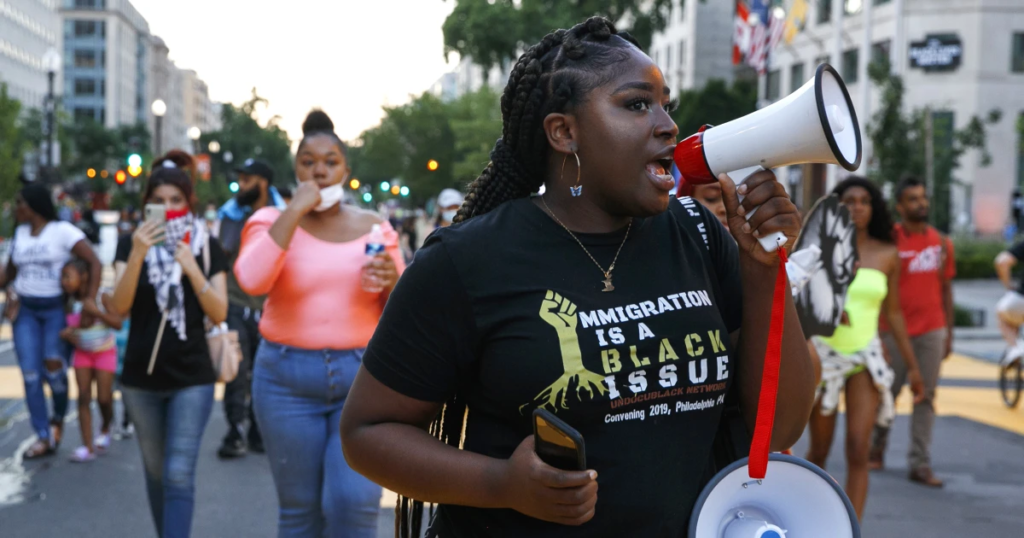
“We really need people who are going to talk about the contributions of immigrants and that their voices need to be heard. They are underrepresented, they are underserved when it comes to politics,” she told Colorado Newsline in 2021. As a State Representative, she led the fight on groundbreaking legislation that created the Immigration Legal Defense Fund, and she continues to advance initiatives that support equity for all.
“I think what we’re seeing is a rollback of human rights and the rule of law in the United States,” says Colorado State Representative Junie Joseph, urging residents to stand in the gap for immigrant communities.
Rep. Joseph helped advance Senate Bill 276 (SB276), which codifies an expansion of Colorado’s immigrant protection policies and limits cooperation with federal agents over civil issues.
In May, Governor Jared Polis signed SB276 into law, but now faces a whistle-blower lawsuit for reportedly directing the state labor department to comply with a federal ICE subpoena seeking data on sponsors of unaccompanied migrant children.
Polis has delayed releasing the data pending a court ruling, prompting protests and sharp criticism from advocates and community leaders.
Finding Common Ground
“This president is going to be in office for the next three and a half years,” Rep. Joseph remarks. “We will be vocal. We will advocate against what he does – the negative things that he does and the way he’s eroding people’s rights – and we need our constituency out there to help out as well.”
“We just have to make sure that we don’t give in to the fear mongering as members of the community and neighbors.”
For Dia and ALG, recent events shine light on the motivation behind the organization’s Breaking Barriers and Building Bridges initiative. He appeals to the community to embrace its collective humanity, saying, “Please get to know people; sit down and ask about their stories, because we all have stories….It doesn’t matter what people look like or where they come from; we all are human beings.”
The invisible borders dividing our world are not just lines on a map, but partitions between people – between justice and policy, and between fear and understanding.
Yet, borders can be crossed. Walls can be dismantled. When we choose empathy and courage over silence and apathy, we begin to redraw the map with a greater understanding of our shared humanity and purpose. The time to act is now.
