
Far from Camelot: A View from a Different Lens
This submission was originally published as an essay in the “Between the Lines“ Substack
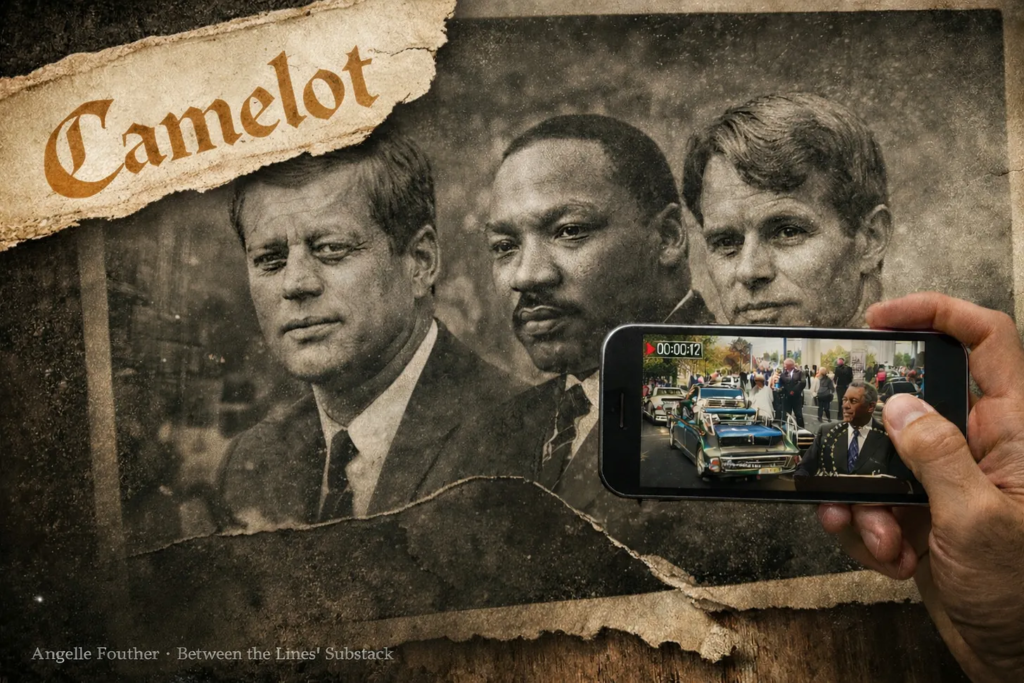
I was maybe in my thirties before I began to encounter the fuller, messier, more stubbornly unfinished stories about John F. Kennedy, Robert Kennedy and Martin Luther King Jr. Not the polished, perfectly bound textbook versions, but the human ones, threaded with contradiction, private struggle, political calculation and intentions that never quite reached conclusion. These fuller profiles didn’t make me respect them less. They made me realize how much of what I had inherited as history had been curation.
And even more, before I had language for narrative power or institutional framing, I noticed something plain: it wasn’t only their lives that were shaped into a simplified format – it was their deaths too.
JFK. RFK. MLK. Three assassinations taught to us as singular, shocking ruptures, followed by explanations so narrow and so neat that the very notion of further inquiry would seem, if not improper, then unnecessary. In practice, those stories didn’t clarify anything; they signaled that the conversation was meant to be over.

I don’t think I was especially unusual in feeling that silence. I think much of the country was trained the same way: absorb the story as delivered, then step aside and let the institutions close the conversation – file away that “inconvenient” chapter of history.
Who gets to validate and circulate truth
Recently, I read a commentary from someone who posited that anyone with a cellphone camera is a journalist now. And while I understood the intention behind the statement, I chicken-bobbed my head back a couple times and side-eyed the assumption.
Journalism still carries discipline, responsibility, context, verification – all the things that keep stories from floating away into rumor or spectacle. What has shifted isn’t who reports. It’s who gets to validate and circulate truth.
How injustice learned to survive in plain sight
For most of this country’s history, injustice didn’t have to hide. It just had to be framed away. It had to be interpreted, buffered, sanitized, smoothed, contextualized by the “powers that be” into a thing the public could swallow without feeling too disturbed by discomfort or contradiction. The system didn’t need secrecy. It needed narrative control.
The civil rights era showed how fragile that control could be. Because what reframed the southern violence wasn’t rhetoric alone. It was what ordinary people saw on televisions in living rooms across the country: bodies and hoses and snarling dogs that did not match the comforting stories white America had been telling itself about what was happening in its own backyard. Those images didn’t explain the system, but they made certain explanations impossible. The visuals created friction where once there had been silence.
The long line of witnesses
You can trace that pattern across the past three decades by paying attention to how often the shift begins with someone unremarkable who simply kept recording.
Rodney King’s beating in 1992 entered public life through a neighbor’s camera. The verdicts that followed told one story. The footage told another. The country had to hold both at once, and that fracture never really closed.
It reopened with Eric Garner’s final words, carried forward because someone chose not to lower their phone. It reopened with Walter Scott running and then falling while a bystander kept filming. It reopened with Laquan McDonald’s killing, held out of public view for more than a year until video refused to remain hidden. It reopened with Philando Castile bleeding beside his partner as the world watched in real time. It reopened with George Floyd’s murder, held in frame by a teenager who did not narrate, did not editorialize, and understood that staying with the moment was itself an intervention.
And it has not stopped reopening.
It is happening now in Minnesota, in cases like Renee Good and Alex Pretti, where community video and witness documentation are forcing public questions that would otherwise have been sealed quickly inside official summaries.
A redistribution of narrative authority
These people were not journalists. They were witnesses. And what they disrupted was not public opinion so much as institutional storytelling.
Reports could still be written. Statements could still be issued. Processes could still unfold on schedule. But those narratives now had to move through a visible record that did not belong to the institution being asked to explain itself. That is a redistribution of narrative authority.
Visibility is not the same as justice
But widening visibility does not guarantee clarity, nor justice. It makes concealment harder, denial costlier, official narratives more vulnerable to public reckoning. It does not itself adjudicate guilt or innocence, nor does it automatically deliver systemic transformation.
The new architecture of noise
The same device that fractured narrative control now lives inside an infrastructure built for velocity rather than understanding: clips stripped of context, emotional acceleration masquerading as insight, comment sections populated by accounts that speak like neighbors but belong to no one. This is not accidental. This is design.
And yet, even inside that engineered noise, something persistently inconvenient has taken root. People have become harder to fully manage – less willing to accept a single authoritative version of events when their own feed contains evidence that refuses to fit. It’s not proof that matters as much as friction – and friction, repeated, bends stories.
What discernment looks like now
This era asks something different: discernment. Not trust without question. Not cynicism without commitment. Just disciplined, steady attention.
Here is what that looks like in practice:
When a piece of footage arrives already shaped to fit perfectly with what you believe, slow down. Ask: Who recorded this? Who released it? When? What sits just outside the frame? What earlier stories does this clip rely on to feel obvious? Whose power is strengthened by how this moment is being interpreted?
And get comfortable revising your first read, using the intelligence and generosity that come from paying attention over time.
The work of staying with the story
The old model depended almost entirely on institutional trust. This one depends on pattern recognition: memory, comparison, context, and the willingness to interrogate what doesn’t line up. There is no shortcut. There is no emotional bypass. There is only work.
That work is not tidy or quick. But it is, finally, hard to undo.
History is no longer shaped only by one lens. It is shaped by whoever refuses to let the moment be closed. And that insistence is where real accountability begins