
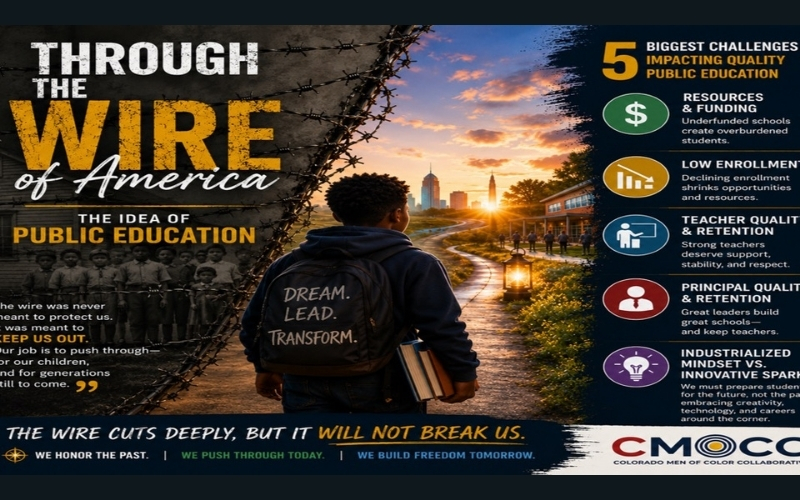
Through the Wire of America: The Idea of Public Education
Written by Dr. Fernando Branch
There is a wire running through America.
It stretches across generations, neighborhoods, school districts and communities. Some can see it clearly. Others pretend it does not exist. For many children – particularly Black, Brown, Indigenous, immigrant and those from low-income households – that wire has always been there. It cuts through opportunity. It divides access. It separates those who are prepared for the future from those who are expected to merely survive it.
One hundred years ago, that wire looked like segregation signs nailed to schoolhouse doors. It looked like tattered textbooks passed down from wealthy schools to poor ones. It looked like children walking miles to underfunded buildings while others rode buses to campuses equipped with libraries, laboratories and endless possibility.

Today, the wire has evolved.
It is hidden beneath policy language, funding formulas, political debates and data reports. It lives inside zip codes. It breathes through inequitable school funding. It survives in teacher shortages, principal burnout, overcrowded classrooms and systems still rooted in an industrial-era model of education that was designed to create compliance instead of creativity.
And yet, despite all of this, there are still brave souls pushing through the wire.
Teachers. Principals. Parents. Community leaders. Students.
They continue to move forward carrying lanterns into the darkness, searching for something generations before them were promised but never fully received: a truly equitable public education.
The Promise of Public Education
Public education was supposed to be America’s great equalizer.
The idea was revolutionary: regardless of race, wealth, background or geography, every child would have access to learning and opportunity. Education would become the bridge to economic mobility, civic engagement and freedom.
History reminds us that the promise of public education has never been distributed equally.
In 1954, the Supreme Court’s decision in Brown v. Board of Education declared segregated schools unconstitutional, acknowledging that separate educational systems were inherently unequal. Yet, more than seventy years later, many schools remain deeply segregated by race and income due to housing policies, district boundaries and funding disparities.
Historian Carter G. Woodson warned us decades ago in “The Mis-Education of the Negro” that systems can be designed not to liberate minds, but to condition them. Paulo Freire later echoed similar concerns in “Pedagogy of the Oppressed,” arguing that education can either function as a practice of freedom or as a tool of oppression.
The uncomfortable truth is this:
The system is not broken.
It is functioning exactly as many parts of it were designed to function.
And if we fail to study history, we become vulnerable to repeating its patterns.

Challenge One: Resources and Funding
The first wire cutting deeply into public education is inequitable funding.
Across America, school quality is often tied directly to property taxes. This means a child’s educational experience can be determined not by potential, but by zip code.
Some schools offer advanced STEM labs, arts programming, mental health services, small class sizes and modern technology. Others struggle to provide updated textbooks, working air conditioning or enough counselors to meet student needs.
According to the Education Law Center, high-poverty districts across the United States frequently receive substantially less funding than wealthier districts serving fewer high-needs students.
This inequity creates layered consequences:
- Limited access to rigorous coursework
- Outdated facilities and technology
- Reduced extracurricular opportunities
- Increased teacher turnover
- Lower student engagement and achievement
The wire tightens when communities are expected to compete for opportunity rather than collectively invest in every child.
A nation cannot claim to value children while simultaneously rationing access to quality education.

Challenge Two: Low Enrollment and Community Disinvestment
Public schools across the country are now facing another crisis: declining enrollment.
At first glance, low enrollment appears to be a numbers issue. But beneath the statistics is something much deeper – community trust.
Families leave school systems for many reasons:
- Concerns around safety
- Lack of academic rigor
- Limited programming
- School closures
- Housing instability
- Competition from charter and private schools
In many urban communities, declining enrollment has created a vicious cycle. Schools lose students, which leads to reduced funding. Reduced funding leads to staff cuts and fewer resources. Those reductions further weaken confidence in the system, leading to even more enrollment loss.
The result is not simply shrinking schools – it is shrinking hope.
And when schools disappear from communities, something sacred disappears with them.
Schools are more than buildings. They are anchors. They are gathering spaces. They are places where identity, culture, mentorship and belonging should thrive.
When a community loses faith in its schools, it often loses faith in the future itself.
Challenge Three: Teacher Quality and Retention
America cannot build world-class schools while exhausting the very people responsible for educating children.
Teachers are leaving the profession at alarming rates.
Burnout, low compensation, political attacks, lack of autonomy, increasing mental health demands and unsustainable workloads have created a profession where many educators feel unsupported and undervalued.
But this crisis is not only about retention; it is also about representation and preparation.
Students deserve highly effective educators who understand both content and culture. Research consistently shows that students benefit academically and socially when they experience culturally responsive teaching and when they see diverse educators in leadership roles.
Yet, schools across the country continue to struggle to recruit and retain educators of color.
The wire cuts deeply when talented teachers enter the profession with passion only to leave because the system demands survival instead of sustainability.
Still, every day, teachers continue showing up.
They buy supplies with personal money. They mentor students beyond contract hours. They feed hungry children. They counsel broken hearts. They carry emotional burdens few professions could withstand.
America owes teachers more than applause. It owes them support; respect; investment; and sustainable systems where they can thrive.

Challenge Four: Principal Quality and Retention
If teachers are the heartbeat of schools, principals are often the nervous system.
Strong school leadership matters.
Research from organizations such as the Wallace Foundation consistently demonstrates that principal effectiveness is second only to classroom instruction among school-related factors influencing student achievement.
Yet principals today are navigating impossible demands:
- Academic recovery
- Staffing shortages
- Student mental health crises
- Community tensions
- Political polarization
- Compliance mandates
- Safety concerns
Many principals are expected to function simultaneously as instructional leaders, crisis managers, counselors, communicators, fundraisers, disciplinarians and political navigators.
And far too often, they do this without adequate support.
Leadership turnover destabilizes school culture, disrupts improvement efforts and weakens trust within communities.
The reality is that schools rise and fall on leadership. Society needs courageous educational leaders who can navigate uncertainty while still protecting joy, innovation and hope. But courage without support eventually becomes exhaustion.
If America truly values educational transformation, it must invest deeply in developing, protecting and sustaining high-quality school leaders.

Challenge Five: Industrialized Education in an Innovative World
Perhaps the deepest wire running through public education is philosophical.
Many schools are still built around an industrial-era model designed over a century ago: Rows. Bells. Compliance. Standardization. Memorization.
Students are often taught to follow instructions more than they are taught to imagine.
The world, however, has changed.
Artificial intelligence is reshaping industries. Technology evolves faster than curriculum cycles. Entire career fields now exist that did not exist ten years ago.
And still, too many classrooms remain trapped in outdated systems preparing students for a world that no longer exists.
The future belongs to creativity. Adaptability. Innovation. Critical thinking. Collaboration. Entrepreneurship. Emotional intelligence. Children today need opportunities to create, build, code, design, lead and solve problems. Education must evolve from simply producing workers to cultivating visionaries.
The industrialized mindset says: “Fit into the system.”
The innovative mindset says: “Transform the system.”
That shift requires courage, because innovation threatens systems built on predictability and control. Our children cannot afford an education system centuries behind the realities they are preparing to enter.
Through the Wire
Despite every challenge, I remain hopeful.
Hopeful because I have seen educators leading in darkness with nothing but vision and faith.
Hopeful because I have seen principals stand in the gap for children society tried to ignore.
Hopeful because I have watched young men once counted out become scholars, leaders, fathers, educators and entrepreneurs.
Hopeful because every generation produces people willing to push through the wire.
The wire may cut. It may scar. It may wound – but it does not have to define us.
There is something powerful about people who continue pushing forward despite adversity.
I imagine those freedom seekers from generations ago walking quietly along riversides under moonlight, seeing lanterns glowing in the distance – tired; hurt; fearful; yet, unwilling to stop. That same spirit still exists today.
It lives inside educators staying late after school. Inside parents and students advocating at board meetings. Inside community organizations mentoring young people. Inside students daring to dream beyond the limits placed upon them.
The new wires may look different – policies, politics, funding battles, technology gaps, systemic inequities – but the mission remains the same: To move toward freedom; toward opportunity; toward dignity; toward a future where every child receives the quality education they deserve.
Public education is still one of the most important ideas America has ever created. But ideas alone are not enough.
It will take courage; collaboration; innovation; and relentless commitment.
The work ahead belongs to those willing to continue pushing through the wire – not simply for themselves, but for generations yet to come.
And somewhere ahead, beyond the bend, the lantern light is still shining.
We must keep moving toward it.
Editor’s note: This content was submitted by a member of the Front Range Focus community. Front Range Focus does not verify the use or non-use of AI tools in community submissions. Readers are encouraged to exercise discretion.