
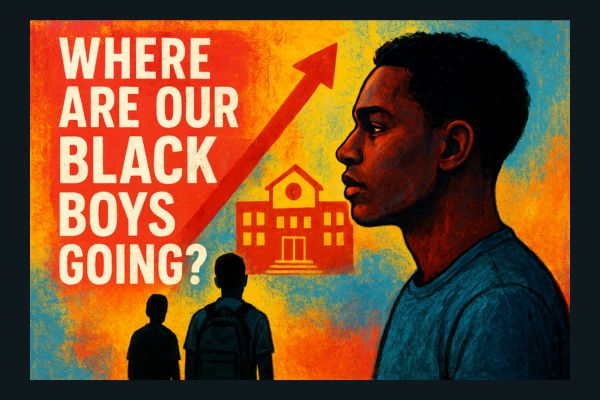
Where Are Our Black Boys Going? A Call to Confront a National Crisis
Across the United States, a quiet crisis is unfolding. It’s one that threatens the future of higher education and the broader promise of equity. According to the National Student Clearinghouse Research Center (NSCRC), Black male college enrollment has declined dramatically in the past decade. The reasons are as deep as they are systemic.
This crisis is not a reflection of individual failure or disinterest. Rather, it is the result of historical exclusion, inequitable systems and cultural narratives that have consistently undermined the potential of Black boys and men.
Systemic Roots of the Problem
The decline in Black male college enrollment is not new. It is rooted in America’s long struggle with educational equity.
After the 1954 Brown v. Board of Education ruling, the desegregation of schools came at an unexpected cost. M.J. Hudson and B.J. Holmes, published a study in the Journal of Negro Education, revealing that more than 100,000 Black educators had been lost. These educators had served as role models, mentors and cultural anchors for generations of students.

In 2023, the U.S. Department of Education (ED) reported that Black men represented only two percent of America’s public school teachers. This lack of representation has profound consequences.
Research shows that having even one Black teacher between kindergarten and third grade increases a Black student’s likelihood of attending college by 19 percent. Representation builds belief; without it, too many students internalize messages that they do not belong in academic spaces.
Additionally, disciplinary inequity continues to derail academic pathways. According to ED’s 2021 Civil Rights Data Collection, the Black boys are suspended at nearly three times the rate of their White peers, often for subjective infractions. Each suspension represents lost instructional time and a blow to belonging. Yet, belonging is the soil in which achievement grows.
Financial and Institutional Barriers
Georgetown University’s Center on Education and the Workforce reports that financial barriers are among the most cited obstacles to higher education for Black men.

Rising tuition costs, coupled with persistent wealth and income disparities, limit access to college and increase debt aversion. Many young Black men face the economic necessity of working to support their families rather than pursuing long-term educational goals.
Even when Black men reach college, they often face racial isolation and campus climates that can feel unwelcoming. Shaun R. Harper, PhD.’s report from the National Male College Achievement Study indicates that Black male students frequently experience microaggressions and discrimination. These experiences negatively impact academic engagement and persistence, while communicating that their presence is tolerated rather than celebrated.
Cultural Crossroads and Masculine Narratives
Cultural dynamics also shape this crisis. In “Beyond Bad Behaving Brothers: Productive Performances of Masculinities Among College-Age Black Men,” Frank Harris III and Harper find that the societal pressure for “masculine toughness” discourages emotional openness and academic vulnerability.
For some young men, immediate financial opportunity – even in informal economies – appears more attainable than long-term academic investment.
Furthermore, the stereotype threat – the fear of confirming negative stereotypes about one’s group – can suppress performance and engagement. Written in 2022, “The Impact of Law Enforcement on the Leadership of Black Male Principals” addresses this phenomenon. When young Black men constantly battle the perception of criminality or intellectual inferiority, it creates an exhausting psychological tax that undermines persistence.
Reclaiming the Promise of Black Excellence
Reversing the decline in Black male college enrollment requires more than policy adjustments – it demands continuous action. Change begins with reimagining what’s possible when every corner of our community takes responsibility for the success of our sons.
Imagine a classroom where a young Black boy looks up and sees a teacher who looks like him, affirms his voice, holds him to a high standard and helps him navigate the unspoken codes of academic success. That kind of representation is necessary to turn the tide and rebuild the Black male educator pipeline. It will restore hope and identity, while providing students with a mirror and a map.
Now, picture a school where discipline doesn’t mean exclusion. Instead of pushing students out for mistakes, we pull them in with restorative practices that teach accountability and self-awareness. In these schools, belonging is the foundation of learning, and every suspension avoided becomes a story reclaimed.

At the same time, our colleges must become places where Black men are not just admitted, but affirmed. Financial support, mentorship and culturally responsive spaces are essential for persistence. Scholarships matter, but so do barbershop conversations on campus, Black male affinity groups and professors who call their names with pride.
Outside of the classroom, we need to activate our community networks. Parents, pastors, coaches, business owners and mentors. We all play a role. Every conversation with a young man about his goals, every job shadowing opportunity and every word of encouragement builds the bridge to his future.
Finally, we must celebrate Black excellence loudly and often. When young men see engineers, artists, educators and entrepreneurs who look like them thriving, the narrative shifts from survival to leadership. The goal is not just to get more Black men into college, but to help them see themselves as builders of culture, community and change.
This is the work before us. It’s systemic and personal, structural and spiritual. It’s not about saving Black boys; it’s about believing in them and building systems that do, too.
Change in Action
At Robert F. Smith STEAM Academy, Denver’s only high school modeled after Historically Black Colleges and Universities (HBCUs), we see daily proof that when belonging meets rigor, Black excellence flourishes.
Our students are scientists, artists, innovators and leaders. They are proof that when we build systems rooted in affirmation, opportunity and purpose, our young people – and specifically our young men – rise.
The question before us is not whether Black men can succeed in college. They can, and they do. The real question is whether we, as a society, will build and sustain systems worthy of their brilliance.
When Black men thrive, America thrives.